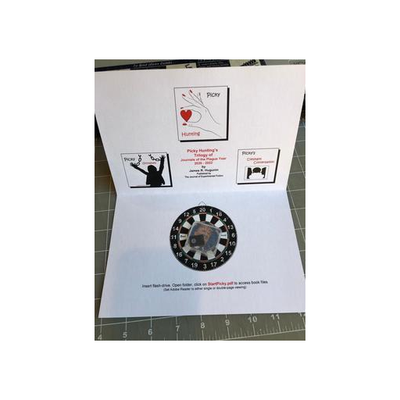
Picky Hunting's Trilogy of Journals of the Plague Year: 2020-2022
James R. Hugunin
$49.95
JEF BOOKS · HARDCOVER · 2015 · ISBN 9781884097607
Case X puts its narrator head-first into a Tomotherapy radiation machine and keeps him there. Across thirty treatments over six weeks, an academic in a life-or-death bout with salivary-gland cancer enters what the book calls skull-time, an inner projectionist running views of his past, present, and future against the white sterility of the treatment room.
The illness is never only biological. The novel treats it as a pervasive disturbance of being in the world, an existential condition rendered through the machine's rhythm. This is Hugunin's ludicakadroman at work, his term for a playful autotheory in which the memory of lived experience is one material among artworks, theory, and other texts.
Hugunin came to fiction late, after decades as one of America's most prolific photography critics and a long teaching run in the History of Photography at the School of the Art Institute of Chicago. The critic's eye carries into the novel: a book about being looked at, scanned, and read, written from inside the machine that does the scanning.
$75.00$45.00
In print, ships in 5–10 days
Backlist price · 40th-anniversary sale
Free US shipping on two or more JEF titles. International — we’ll quote you.