
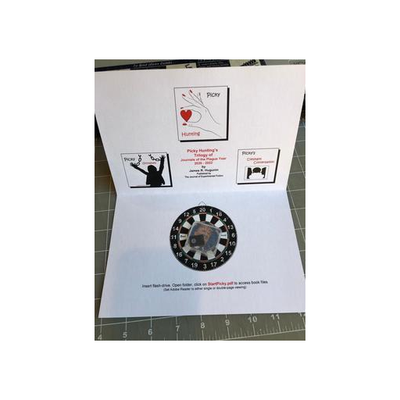
Picky Hunting's Trilogy of Journals of the Plague Year: 2020-2022
James R. Hugunin
$49.95
A room in the house of JEF
Authors / James R. Hugunin
★ House author
1947 ·
JEF Books has published twelve James R. Hugunin titles since 2012, from his photography criticism to the Picky Papers trilogy of pandemic autotheory.
The shelf
← drag · scroll · arrow keys →
James R. Hugunin
$49.95
James R. Hugunin
$51.00
$85.00

James R. Hugunin
$89.95
James R. Hugunin
$40.00
$45.00

James R. Hugunin
$75.00

James R. Hugunin
$85.00
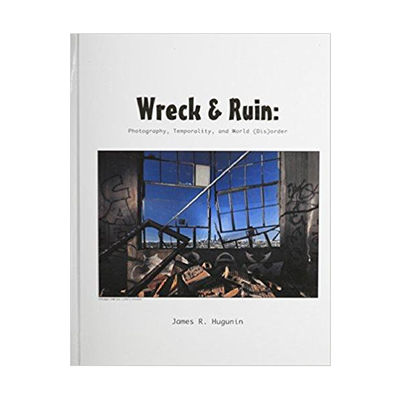
James R. Hugunin
$58.00
$65.00
James R. Hugunin
$75.00
James R. Hugunin
$76.00
$84.96
James R. Hugunin
$45.00
$75.00
James R. Hugunin
$52.00
$75.00
11 titles · 2012 – 2021 · all in print
The bio
James R. Hugunin (b. June 20, 1947, Milwaukee) is one of American photography criticism's most prolific living voices and, since 2012, a core JEF Books experimental novelist. His work sits at an unusually productive seam: forty years of conceptual-photography criticism feeding into a late-blooming fiction practice that he calls ludicakadroman, a playful species of autotheory in which the memory of lived experience is one material among artworks, theory, and other literary texts.
He came up through a Southern California art-school pipeline: U.S. Air Force photographer (1967-1971), then architectural and product photography at Art Center College of Design in Los Angeles, a B.A. in Fine Art from California State University, Northridge (Magna Cum Laude, 1973), and an M.F.A. from UCLA in 1975. He spent the late 1970s in Hollywood special effects and the printing industry, working as a photographer on Star Trek: The Motion Picture (1979). In 1983 the NEA and the Photographic Resource Center in Boston named him the first-place winner of the inaugural Reva and David Logan Award for Distinguished New Writing in Photography. He spent 33 years (1985-2018) as Adjunct Full Professor of Art History, Theory, and Criticism at the School of the Art Institute of Chicago, where he is now emeritus.
He founded the Los Angeles art journal The Dumb Ox (1976-1980) and the journal U-Turn (1982), which since 1998 has run as U-Turn E-zine. His scholarly monograph A Survey of the Representation of Prisoners in the United States: Discipline and Photographs appeared from Edwin Mellen Press in 1999.
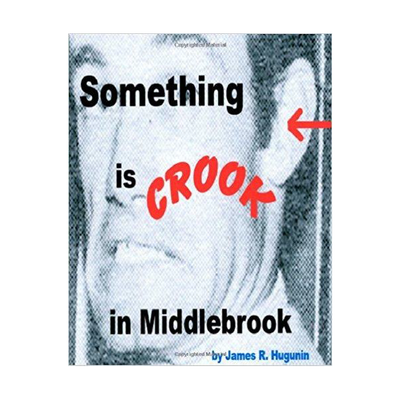
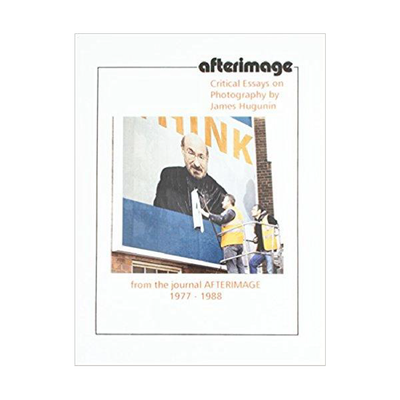
JEF Books has published twelve of his titles, spanning his photography-criticism anthologies (Writing Pictures, Wreck and Ruin, Afterimage) and a run of nine experimental novels beginning with Something Is Crook in Middlebrook (2012), named "Best Experimental Novel of 2012" by Derek Pell, and culminating in the Picky Papers trilogy: Picky Hunting: A Journal of the Plague Year (2021), Picky Unchained (2022), and Picky's Constant Conversation (2022), over 1,100 full-color pages of pandemic autotheory.
He was elected to Chicago's Society of Midland Authors in 2016 and lives in Santa Fe, New Mexico, with his wife Marianne, a psychoanalyst.
Start with Something Is Crook in Middlebrook, the debut novel and the cleanest introduction to the voice before the Picky Papers run.
From the editor
Jim came to fiction at sixty-five, after forty years of writing about photographs. The first novel arrived in 2012, Something Is Crook in Middlebrook, and Derek Pell called it the best experimental novel of the year. I had been reading Jim's criticism in Afterimage and Artweek since the eighties and did not know he had a novel in him until the manuscript turned up. He had been preparing it, it turned out, the whole time. The practice he calls ludicakadroman is what a critic produces when the critic stops protecting the line between the writing about and the writing of. Twelve JEF titles since, including the Picky Papers trilogy: eleven hundred full-color pages of pandemic-era autotheoretical novel split across three volumes, all of it written between 2020 and 2022. It is one of the long arcs of this catalogue.
Eckhard Gerdes · founding editor, JEF
Elsewhere on record
For students, for librarians, for the next biographer. We do not embed; we link out.
Only James R. Hugunin, of all people on the face of this planet, could have written this work.
— Eckhard Gerdes